A cord that feels lovely in the hand can be a misery to knot. It kinks on the second pass of a Turk’s head, the tail frays before you have finished whipping it, and the monkey’s fist you were proud of goes soft and lopsided overnight. That is rarely your fault. It is the construction.
Almost every cord you can buy falls into one of two families: twisted (also called laid) rope, where strands spiral around each other, or braided rope, where strands interlace. Within those families sit dozens of variations, and each one behaves differently at the bench. Knowing which is which turns a frustrating afternoon into an hour of steady, satisfying work.
Twist and Lay: The Three-Strand Basics
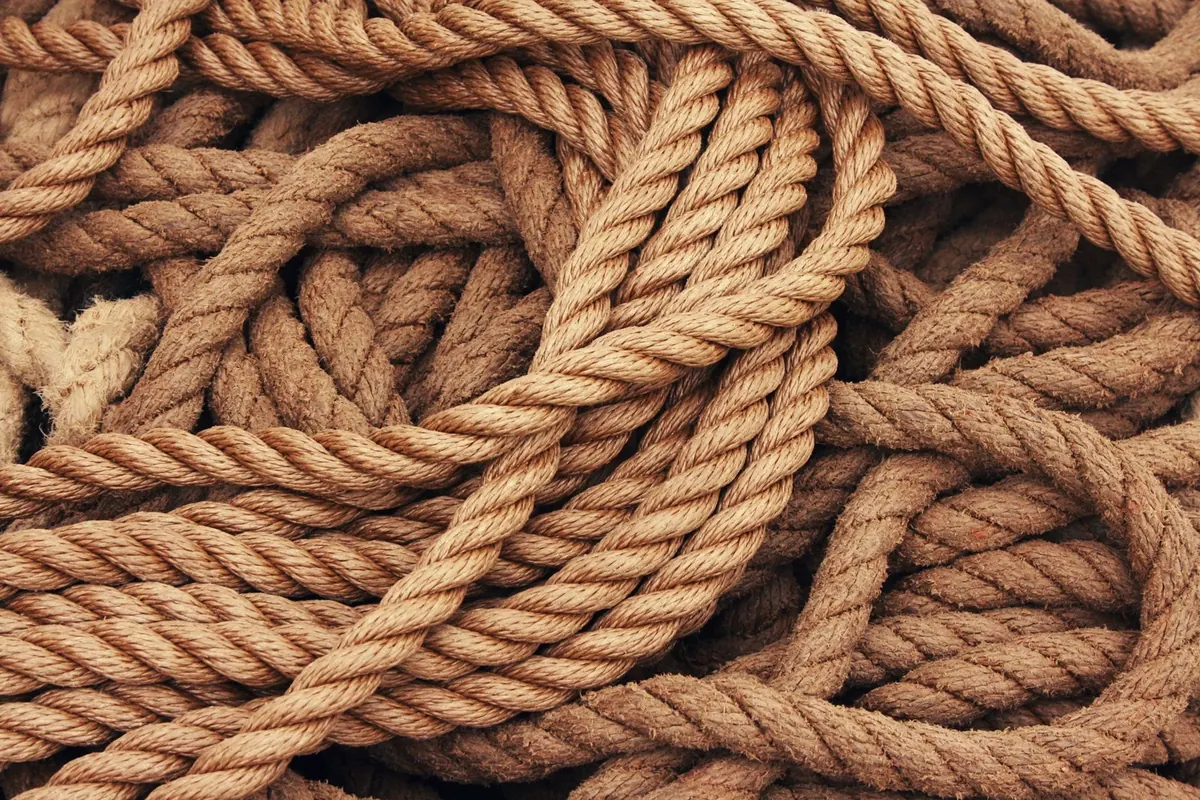
Three-strand rope is the oldest idea in cordage and still the most recognisable. Three yarn bundles, called strands, are twisted around one another in a helix. The direction of that twist is the lay: right-hand lay, twisting clockwise away from you, is the standard for most general rope; left-hand lay runs the other way and is used in a few specialist applications.
Lay also refers to tightness, and this is where handling changes dramatically.
Hard lay versus soft lay
A hard-lay three-strand has its strands twisted tightly. It comes off the spool firm and round, resists abrasion well, stretches little, and holds a shape once knotted. It is also stubborn. Tight turns are difficult, the rope fights back when you try to dress a knot, and it kinks readily under load. For plant hangers, doormats, fenders, and decorative work where you want crisp geometry that stays put, hard lay is the better choice.
A soft lay is looser and more supple. It bends easily, snugs down smoothly, and feels kinder in the hand. The trade-off is that it flattens under load, wears faster where it rubs, and stretches more. For practising knots, for anything that needs to draw up tight, soft lay is the friendlier option.
Three-strand rope grips knots well for a simple reason: the surface is never smooth. The raised crowns of the strands give friction, and the rope deforms slightly inside a knot so the parts lock together. Two cautions, though. A twisted rope loaded while it is twisted will hockle — developing permanent kinks that never come out. And a cut end unravels quickly, faster than any braid, so finish it before you start tying.
What Braid Changes
Braid interlaces strands instead of twisting them. Because there is no built-in twist direction, braided cord does not try to rotate under load — the reason it is preferred wherever a line hangs free or runs through a ring. It is generally more supple, far less prone to hockling, and holds a rounder cross-section.
The main types you will meet:
- Solid braid. The outer strands interlock in a way that locks the whole structure together, so the cord stays firm and round and does not hollow out when you bend it. Excellent for decorative knots that need to keep their shape: key fobs, lanyards, monkey’s fists. It does not splice by the burying method.
- Hollow braid. Eight or twelve strands woven as a tube with no core. Extremely supple, easy to splice by burying a tapered tail inside the tube, and smooth enough that knots can creep. Good for slings and any project where you want a clean splice rather than a knot.
- Double braid. A braided core inside a braided cover. Strong, low stretch, firm in the hand, spliceable with the right technique. The workhorse for structural and outdoor work, and the most expensive of the three.
The cost of braid’s smoothness is grip. Fine filaments sliding over one another inside a knot offer less friction than the bumpy crowns of a twisted rope, so a bowline or an adjustable loop may creep unless you add extra tucks or a stopper.
Knot Hold: What Actually Grips
Three things determine whether a knot holds: surface texture, contact area, and how much the cord deforms inside the knot. Twisted rope wins on texture and deformation. Slick hollow braid loses on both. Stiffness cuts both ways — a cord too stiff will not bend tightly enough for the knot to lock, while one too soft flattens and creeps.
If the knot slips in a 30 cm offcut, it will slip in the finished piece.
Test before you commit. Tie the actual knot you plan to use in a scrap of the actual cord, load it by hand as hard as you reasonably can, and look for movement at the tail. Then consider:
- For anything that must not slip — adjustable loops, drawstrings, lanyard necks — choose a cord with some texture and a slightly softer hand, and finish with extra tucks, a stopper knot, or a seizing.
- For decorative knots where shape matters more than grip, choose a firm cord that takes a set: solid braid, hard-lay three-strand, or a stiff natural fibre such as sisal.
- For anything load-bearing, remember that a knot is the weak point and can easily halve the strength of a cord. Work well below the cord’s rating, inspect regularly, and never use a decorative knot for lifting or life safety.
Cutting and Finishing Without the Fray
Braid frays more slowly than twist because the interlacing resists unravelling, but every cord needs a finished end. A workable sequence:
- Wrap tape firmly either side of the cut line so nothing moves while you cut.
- Cut with a sharp blade. For synthetics, a hot knife or soldering iron seals as it cuts and saves a step.
- For synthetics, briefly melt the tip into a rounded bead. A bead, not a blob — a heavy blob will not pass through a tight knot.
- For natural fibres, whip the end with waxed thread. Tape alone is temporary and will fail at the worst moment.
- For hollow braid, cut long, taper the tail, and plan the bury before you finish the end.
Store finished cord out of direct sun and away from solvent fumes, which degrade synthetics quietly over months.
Matching Cord to the Project
With construction understood, choosing becomes straightforward:
- Practice and samplers: inexpensive soft-lay three-strand, 4–6 mm. Forgiving and cheap enough to cut freely.
- Key fobs, lanyards, monkey’s fists: solid braid, 6–8 mm, for shape retention.
- Turk’s heads, bracelets, napkin rings: supple braid with a firm hand in cotton or polyester.
- Plant hangers and structural knot work: hard-lay three-strand or double braid, 6–10 mm.
- Leads and handles: double braid or three-strand nylon, which absorbs shock; check fittings as often as the cord.
- Splicing projects: hollow braid, or double braid if you want a jacketed finish.
A note on fibre
Nylon is strong and stretchy and takes shock well, but degrades in sunlight. Polyester is the general workhorse: low stretch, good UV resistance, predictable. Polypropylene floats and is slippery and short-lived outdoors. Cotton is soft and knots beautifully but frays and mildews. Hemp, jute, sisal, and manila give excellent grip and texture for decorative work, though they rot if stored damp. Paracord-type cords with a sheath over parallel core strands hold knots well, but the sheath can shift against the core in some knots, so seat it firmly as you dress the work.
A Short Buying Checklist
Buy a metre each of two or three candidates rather than committing to a full spool. Tie the exact knot your project needs, load it, and watch for slip, kink, and fray at the cut end. Notice how the cord feels after ten minutes — a stiff rope that fights every pass will wear you down on a large piece. Write down what worked and what did not; a small notebook of cord samples saves more time than any chart. Then buy the spool with confidence, finish your ends properly, and let the construction do its job.
Photo: Pixabay / Pexels